
Publications
Theses
Mia Neubauer
PhD thesis: Differenzierung neuropsychologischer Post-COVID-Symptome anhand der Herzfrequenzvariabilität
Description: As part of the doctoral thesis, heart rate and heart rate variability will be analysed during the virtual reality memory task. The aim of the study is to examine the activity of the cardiovascular autonomic nervous system in post-COVID patients during the task and how it differs from that of healthy control subjects. In addition, the relationship with specific neuropsychological symptoms, in particular fatigue and cognitive impairments, will be investigated.
Joy Sarow
Master's thesis: Temporal Dynamics of Object-Location Memory in Prodromal Alzheimer's Disease and Healthy Aging: An Immersive Virtual Reality Approach
Supervisor:
- Dr. Stephan Krohn, Charité Berlin, Bereich kognitive und experimentelle Neurologie
- Prof. Dr. Carsten Finke, Charité Berlin, Bereich kognitive und experimentelle Neurologie
- Prof. Dr. Milena Rabovsky, Universität Potsdam, Bereich kognitive Neurowissenschaften
Description: This thesis was written as part of the EPSILON project and utilised its immersive virtual reality task to investigate the temporal dynamics of spatial memory performance. The findings highlight the potential of time-resolved data and provide additional insights into cognitive processes that remain hidden in conventional analyses of mean values.
Aylin Gabrielle Arslan
Master's thesis: Erfassung physischer Ermüdung in VR-Szenarien mittels Bewegungs-, Herzfrequenz- und Augenverhaltensdaten
Supervisor: Dipl.-Psych. Paul Chojecki, Fraunhofer Heinrich Hertz Institut, Gruppe Interaktive und kognitive Systeme
Initial assessor: Prof. Dr. Marc Alexa, Technische Universität Berlin, Fachgebiet Computer Graphics
Second reviewer: Prof. Dr.-Ing. Sebastian Möller, Technische Universität Berlin, Fachgebiet Quality & Usability
Description: The aim of this Master’s thesis is to investigate whether, and in what way, physical fatigue is reflected in measurable data. To this end, a virtual reality (VR) simulation is being developed to record and analyse data on movement, eye movements and heart rate. The interactive VR tasks are designed to specifically induce physical exertion. Based on this data, specific parameters will be identified that allow conclusions to be drawn about physical fatigue. The data obtained will then be compared with measurement data from post-COVID patients from the EPSILON project at the Fraunhofer Heinrich Hertz Institute in order to identify possible commonalities.
Fabio Henn
Master's thesis: Eye Movement Patterns During Visual Encoding in People With Post-COVID Symptoms Using Immersive Virtual Reality
Supervisor:
- Dr. Angelika Thöne-Otto, Klinik für kognitive Neurologie, Universitätsklinikum Leipzig
- Dr. Julia Belger, Klinik für kognitive Neurologie, Universitätsklinikum Leipzig
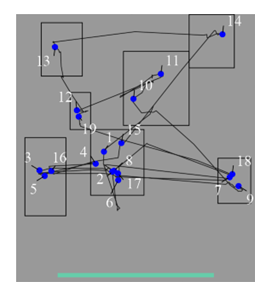
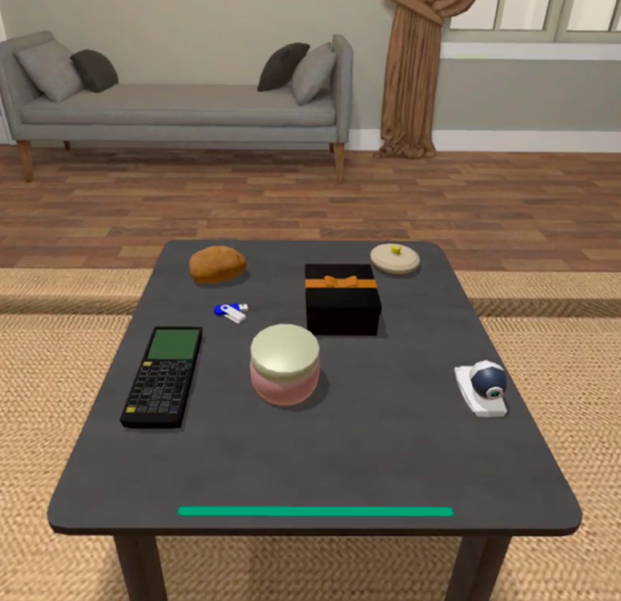
Description: This master's thesis investigates whether eye movement patterns during the encoding of object locations in the Mobile Immersive Virtual Memory Task (mimVMT) differ between individuals with post-COVID symptoms and healthy controls. To address this question, an immersive virtual reality task with integrated eye tracking is used to continuously assess visual exploration and spatial memory processes under ecologically valid conditions. Furthermore, the study examines how eye movement patterns (e.g., fixation duration, number of object-related fixations, and scanpaths) change over the course of the task, whether they predict subsequent object-location memory performance, and how they relate to neuropsychological performance in the domains of attention, executive functions, and memory. Initial findings suggest that eye movement patterns during encoding differ only marginally between groups and that no pronounced group-specific changes emerge over the course of the task. At the same time, individuals with post-COVID symptoms tend to blink more frequently than healthy controls. As further analyses are still ongoing, these findings should be considered preliminary.
Scan path of one example trial during the mem-phase